
On Boredom
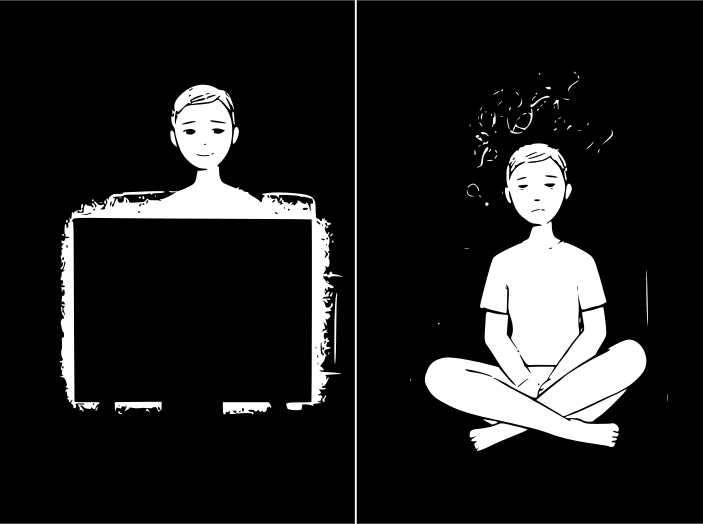
Last week, I finished a 3-month-long, harrowing medical school semester. It ended with the much-dreaded internal medicine "long case" exam where a patient, an exam room (really a ward cubicle), and an examiner are all randomly allocated to one student. You have one hour to take history, examine the patient, and produce a management plan.
Much as the whole thing is stressful, it keeps you busy. Large-volume textbooks, stacks of journal articles; there's always something demanding your attention. And that's a good thing.
Fast forward to the day after, and my calendar is totally free. I'm lying on my bed, staring at the ceiling, in a white undershirt and gray shorts, at 8 pm, head propped up by a pillow, switching positions, sweating in the sweltering heat. I have nothing to do.
Earlier in the day, I had gone through my typical pastimes: scrolling X, watching Instagram reels, reading non-fiction (currently Boris Johnson's The Dream of Rome), listening to podcasts (2025 BBC Reith Lectures). I watched an episode of a TV show. I listened to my favorite Spotify playlist. None of this should surprise you given my average daily screen time of 7 hours and 30 minutes (my iPhone never fails to shame me every Monday at 9 am).
It is at this point that I encourage my reader to be unlike me and engage in more outdoorsy activities.
Having burnt through my leisure options, there was nothing left to do in that hour. It was just me and my thoughts. And there's nothing an idle mind does better than wander and replay cringe memories—from faux pas committed years ago (long forgotten by all living beings except me, of course), to the uncomfortable eye contact I made with someone earlier that week, to how I need to get rich quickly, to that unrequited crush I'm embarrassingly still infatuated with.
Which brings me to the question: what causes boredom?
Boredom is not so much a bug as it is a feature of how our conscious brains are designed.
Except for the 6–8 hours of sleep we get, the majority of the day is spent awake with our brains like a perpetually running engine. No millisecond passes without neurons firing somewhere. If you pay attention to your body (or if idleness forces you to), you'll feel every tiny itch on your skin, hear every faint sound, notice the pressure of your foot against the floor, the ambient heat, the sweat down your chest, the dryness in your throat, the fullness in your bladder. This default hypervigilance probably served an important purpose in our hunter-gatherer past—where predators were a real concern, and constant sensory alertness meant survival.
In modern life, where the threat you are most likely to encounter is a mean remark from a friend, those ancient circuits have nowhere to direct themselves. So they turn inward. The brain's background buzz, normally drowned out by tasks, deadlines, and structured stress, steps forward into consciousness. Suddenly you're seated in a sea of unwanted sensations, emotions, and thoughts.
Fortunately, the magic of physiology dictates that one strong enough stimulus can shove all this background noise back where it belongs. This can take the form of an hour-long scroll through Instagram reels, a good movie, a football game on TV, a run, or hanging out with a friend. Just find a strong enough signal to drown out the noise. Simple, right?
But this knowledge can also be used more cunningly. If you find yourself without an external stimulus, you can play an "Uno reverse" card on boredom: use the boredom itself as the stimulus. Instead of running from the discomfort, stand outside it like a detached observer. Look at how absurd it is that your own physiology is essentially bullying your "self."
When a particularly sharp thought pops up—a cringe memory or a wave of inadequacy—tease your brain like a naughty child trying to annoy their friend. Interrogate it with incessant "whys" and "hows" until it cracks. It says: "I feel sad." You ask: Why? "Because I’m secluded." Why? "Because I’m shy." Why? "Erm..because..." Keep digging until the internal logic suffers a hilarious breakdown. Eventually, you realize the architect of your misery is just a collection of neurons making claims they can't actually defend.
Today we've done two things. We've defined boredom as the uninvited intrusion of the subconscious into the spotlight of awareness, and we've found two ways to fight it: drowning it out with the world, or dismantling it from the inside.
I sometimes wonder whether other living things ever feel bored; and if so, what shape boredom takes for them. But perhaps that's a question for another empty evening.